AI for process reliability in chemical manufacturing and beyond
Detect deviations early. Diagnose the fault mechanism. Act before production is impacted.
Faults spread through interconnected processes. By the time a conventional alarm is triggered, the problem may already have propagated far from where it began. Industrial plants collect enormous amounts of process data, yet most monitoring systems show where abnormal behavior appears — not where it starts. Engineers are then left to trace the problem manually, often taking days to weeks to identify the root cause and delaying corrective action.
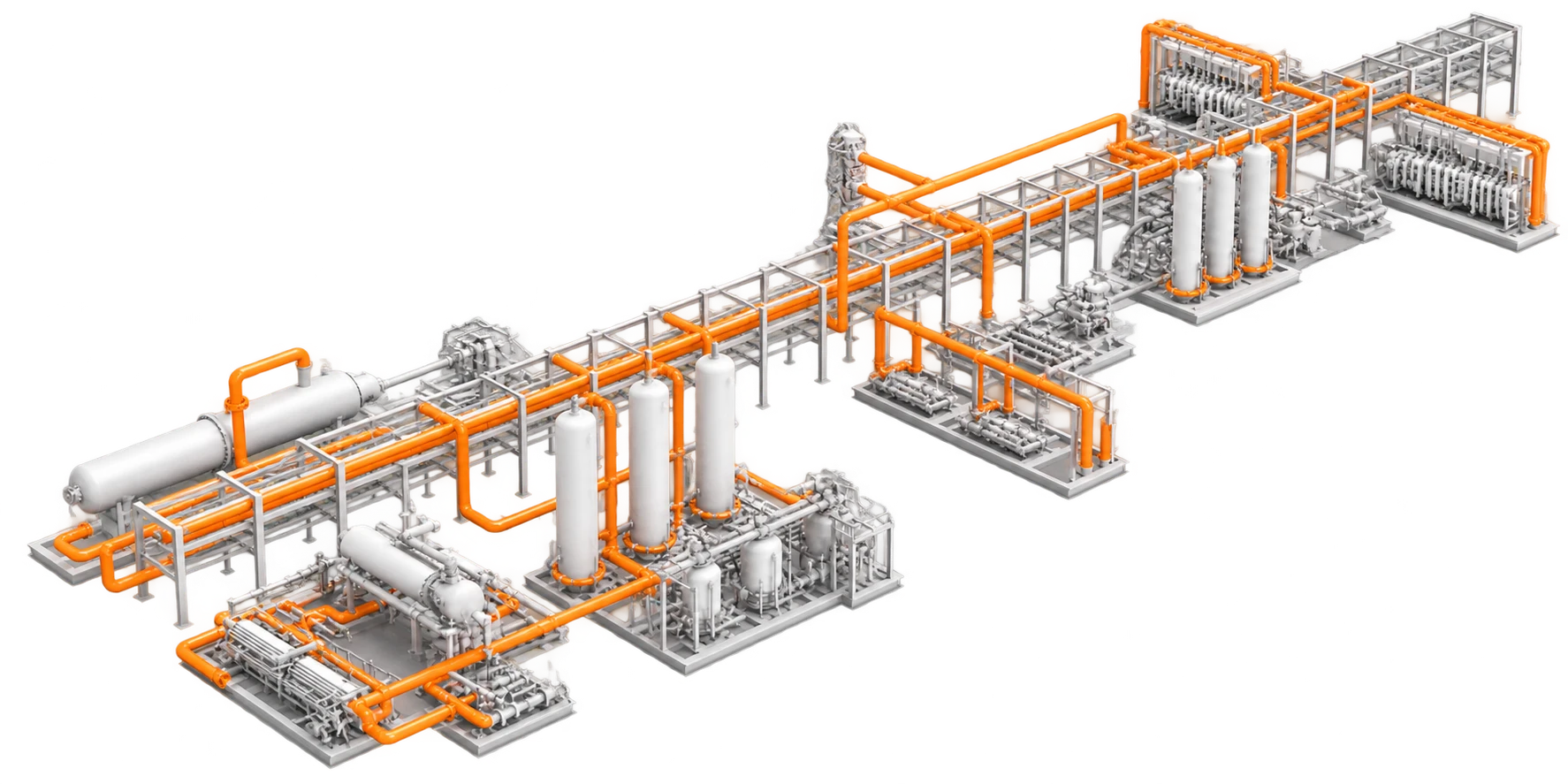
Fouling, crystallization or a partial blockage develops in one part of the process.
Pressure, flow and temperature begin to deviate. Controllers compensate, and alarms multiply across the system.
Only later do asset-level indicators such as vibration or temperature reveal the problem. By then, engineers must trace the disturbance back to its origin while keeping production running.
Overall Equipment Effectiveness (OEE) combines availability, performance and quality to measure how much on-spec output a plant produces relative to its planned production capacity. Move the sliders to see how losses in each factor affect the overall result.
76% × 60% × 90%
A 5-point OEE increase means 12% more on-spec output at the same planned production time and design rate.
KIIO guides engineers and technicians from early fault detection to root-cause verification and corrective action across the production line. It connects to existing process data in read-only mode, requires no new hardware, and keeps engineers in the loop at every step.
Instead of generating another alarm, KIIO detects emerging process deviations, shows where the problem is likely originating, explains how it is propagating through the process, and quantifies its severity and diagnostic confidence. Engineers can then verify the most likely causes using the available process evidence and decide how to intervene, with KIIO providing interpretable guidance throughout the process.
Track how process variables and control actions relate to each other as operating conditions change.
Identify whether a fault likely starts in a sensor, an actuator or the process itself, and trace how its effects spread.
Estimate how severe a fault is and how confident the diagnosis is, helping your team decide what to investigate first.
Give process and maintenance teams likely explanations and specific checks to verify them.
KIIO combines process structure with operational data through a physics-informed graph AI engine. Using the plant’s P&ID and control actions as physical context, it learns the dynamics and interactions that govern normal process behaviour.
Because the model learns self-supervised from normal operation, it does not depend on historical fault examples or predefined fault libraries — an important advantage in industrial environments where faults are rare and highly process-specific.
We use the plant’s P&ID (Piping & Instrumentation Diagram) as a structural inductive bias, encoding how process variables are physically connected. A graph neural network then learns their normal interactions from operational data and detects when these relationships begin to shift as a fault develops.
KIIO explicitly distinguishes process measurements from actuator and control inputs, modelling how control actions enter and influence the process dynamics. This lets the model account for commanded changes and different operating modes, improving its ability to distinguish normal control responses from genuine process deviations.

Industrial data are noisy, incomplete, and irregularly sampled, while interconnected processes introduce inherent time delays between cause and effect. KIIO is designed to handle these real-world conditions and scale across large, complex production systems.
KIIO is an EPFL spin-off based in Lausanne, building interpretable AI for proactive process reliability. We combine research in graph machine learning and dynamical systems with deep knowledge of industrial processes to turn complex plant data into insights engineers can act on.
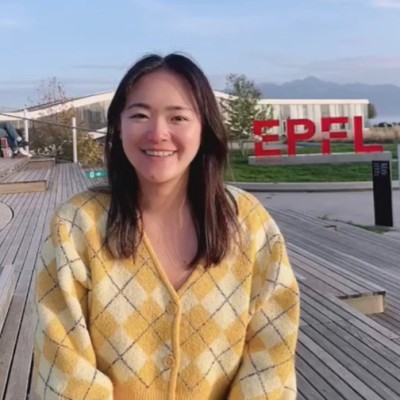
Industrial AI, graph neural networks for complex systems, and predictive maintenance.

15+ years at Nestlé, Michelin and Walgreens. Experience in enterprise B2B; second-time founder.

Experienced chemist and entrepreneur in sustainable chemical manufacturing.
We are turning cutting-edge research into technology that helps engineers understand problems before they escalate. Join us in building the next generation of industrial intelligence and bringing clarity before failure.
Tell us about your process and the faults you want to investigate. With historical data and documented incidents, we can assess the case together and plan an offline proof-of-value study.